
Press Ctrl+ and K to search
目录
学习了 InfulxSQL 与 聚合函数以后,我们来进行一次实战,结合 InfluxDB 来实现物联网监控系统
项目背景与架构设计
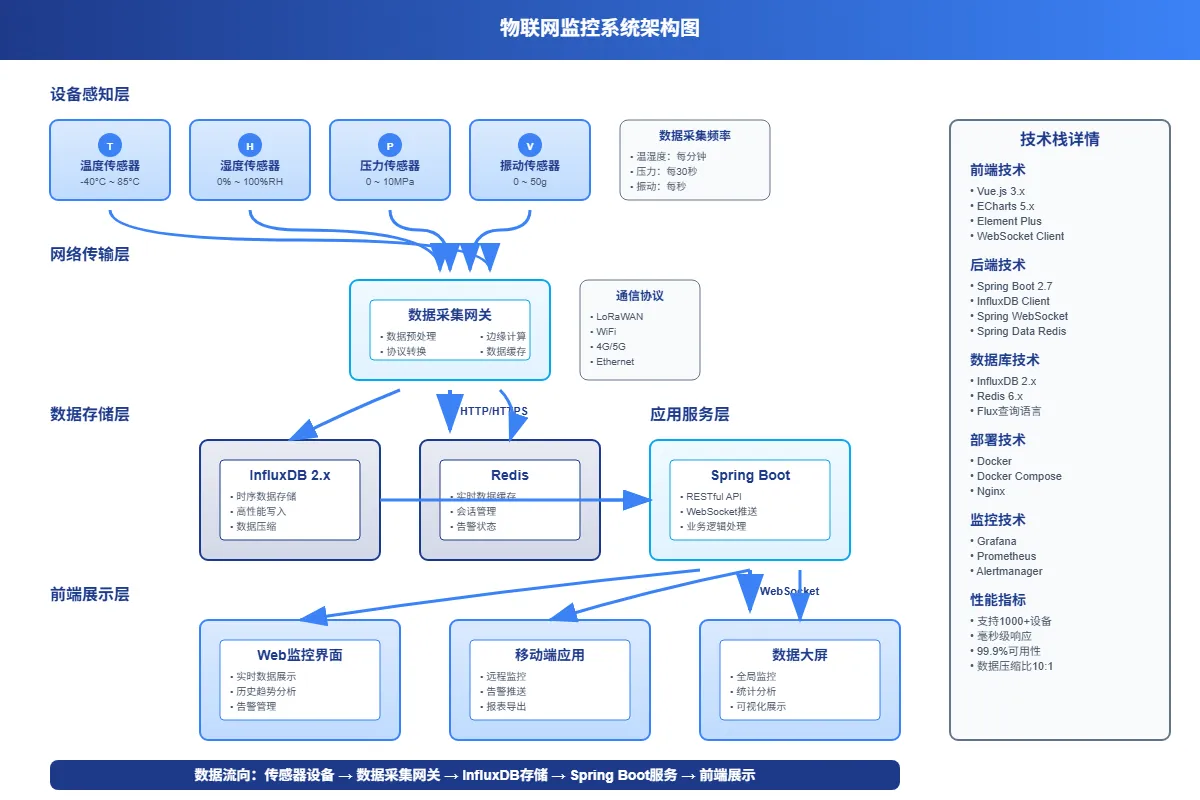
物联网监控系统整体架构与数据流
技术选型对比分析与决策矩阵
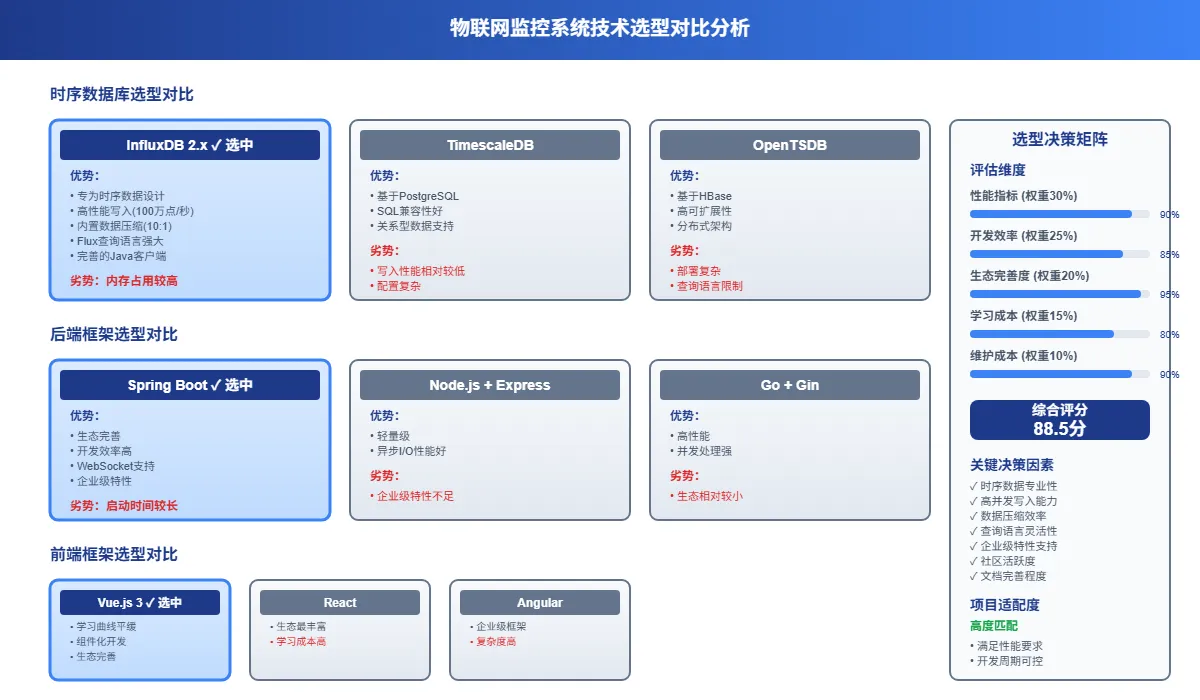
假设你要为一个智能工厂搭建监控系统,需要实时采集温度、湿度、压力、振动等传感器数据,并提供实时监控和历史数据分析功能。这种场景下,InfluxDB是最佳选择。
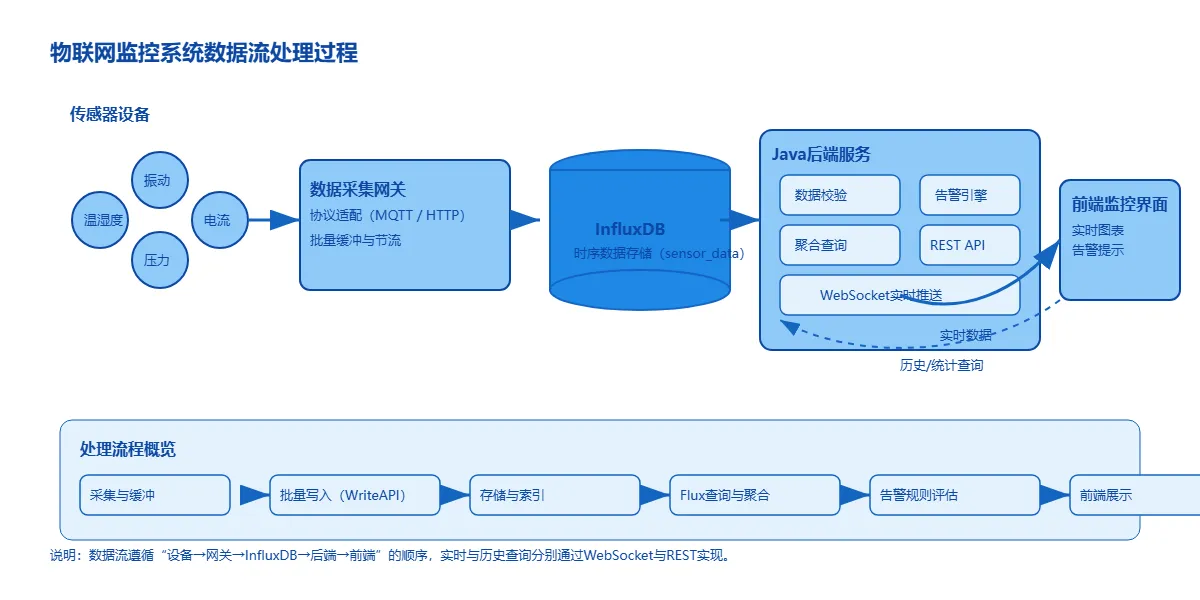
我们的系统架构包含几个核心组件:传感器设备、数据采集网关、InfluxDB存储、Java后端服务、Web监控界面。整个数据流是这样的:传感器→网关→InfluxDB→后端API→前端展示。
系统需求分析
数据采集需求
- 支持多种传感器类型(温湿度、压力、振动、电流等)
- 数据采集频率:每秒到每分钟不等
- 设备数量:100-1000个传感器节点
- 数据保留:实时数据保留7天,聚合数据保留1年
监控功能需求
- 实时数据展示和告警
- 历史趋势分析
- 设备状态监控
- 数据导出和报表生成
技术架构选型
数据存储层
- InfluxDB 2.x:时序数据存储
- Redis:缓存和会话管理
应用服务层
- Spring Boot:Java后端框架
- InfluxDB Java Client:数据库连接
- WebSocket:实时数据推送
前端展示层
- Vue.js + ECharts:数据可视化
- Element UI:界面组件
InfluxDB 数据模型设计
InfluxDB 数据模型结构与查询策略
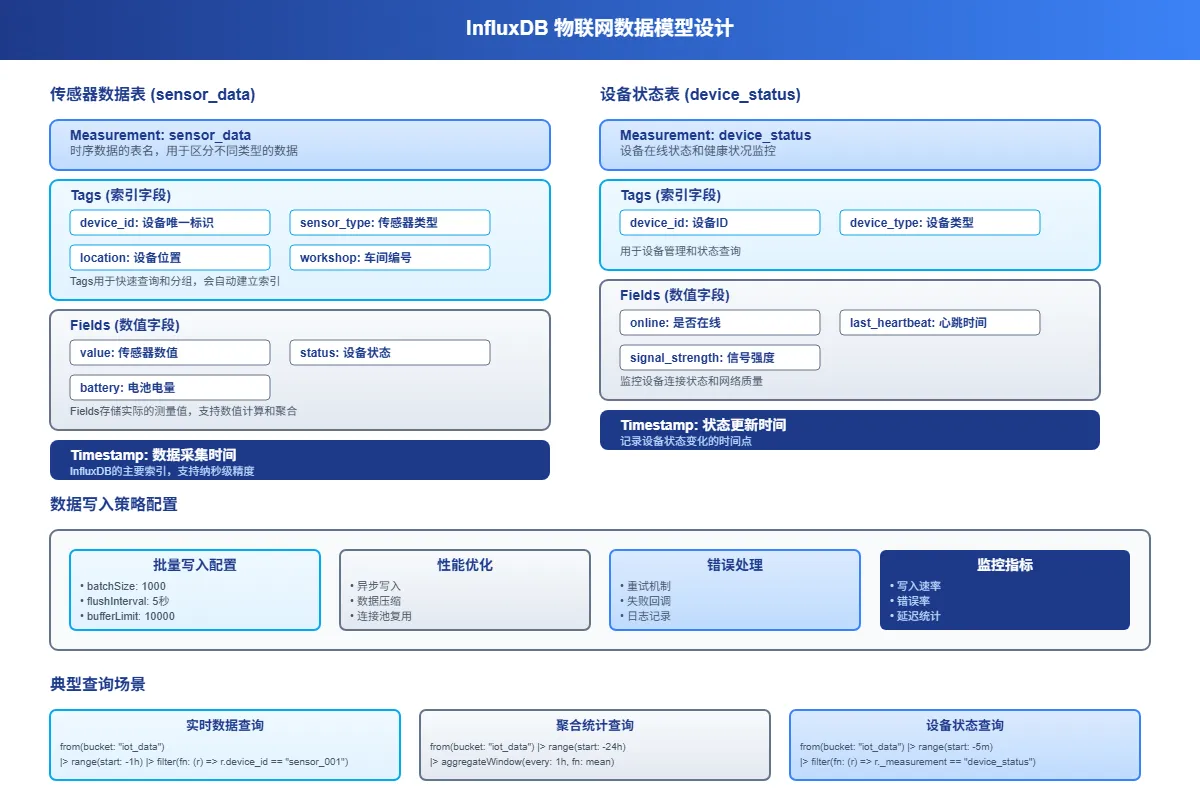
数据结构规划
根据物联网场景的特点,我们设计如下的数据模型:
传感器数据表(sensor_data)
textmeasurement: sensor_data
tags:
  - device_id: 设备ID
  - sensor_type: 传感器类型(temperature, humidity, pressure等)
  - location: 设备位置
  - workshop: 车间编号
fields:
  - value: 传感器数值
  - status: 设备状态(0正常,1异常)
  - battery: 电池电量(可选)
timestamp: 数据采集时间
设备状态表(device_status)
textmeasurement: device_status
tags:
  - device_id: 设备ID
  - device_type: 设备类型
fields:
  - online: 是否在线
  - last_heartbeat: 最后心跳时间
  - signal_strength: 信号强度
timestamp: 状态更新时间
数据写入策略
考虑到物联网设备的特点,我们采用批量写入策略来提高性能:
java// 批量数据写入配置
WriteOptions writeOptions = WriteOptions.builder()
    .batchSize(1000)           // 批量大小
    .flushInterval(5000)       // 5秒刷新一次
    .bufferLimit(10000)        // 缓冲区大小
    .retryInterval(1000)       // 重试间隔
    .build();
Java后端服务实现
Java后端服务架构与组件关系
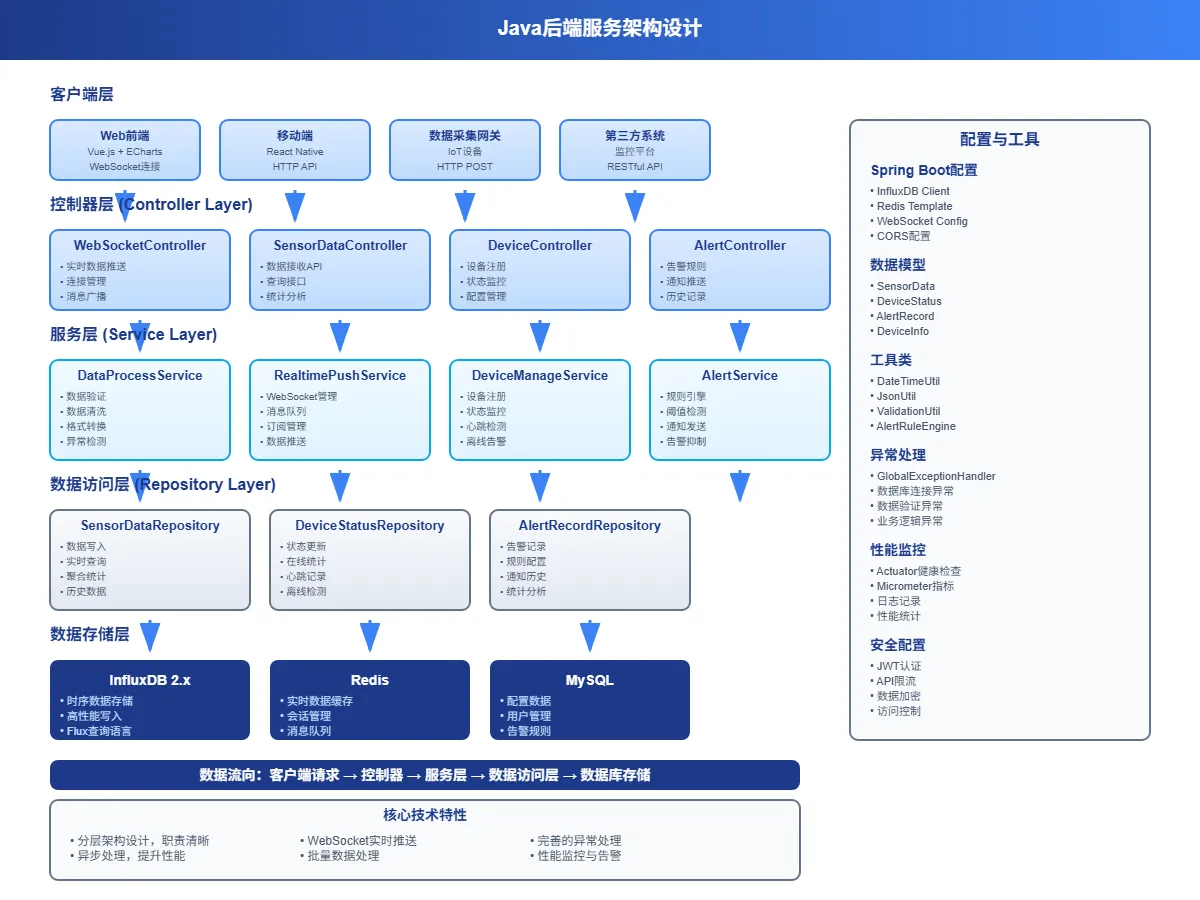
物联网监控系统数据流处理过程
项目依赖配置
xml<dependencies>
    <dependency>
        <groupId>org.springframework.boot</groupId>
        <artifactId>spring-boot-starter-web</artifactId>
    </dependency>

    <dependency>
        <groupId>org.springframework.boot</groupId>
        <artifactId>spring-boot-starter-websocket</artifactId>
    </dependency>

    <dependency>
        <groupId>com.influxdb</groupId>
        <artifactId>influxdb-client-java</artifactId>
        <version>6.7.0</version>
    </dependency>

    <dependency>
        <groupId>org.springframework.boot</groupId>
        <artifactId>spring-boot-starter-data-redis</artifactId>
    </dependency>

    <dependency>
        <groupId>com.alibaba</groupId>
        <artifactId>fastjson</artifactId>
        <version>2.0.25</version>
    </dependency>
</dependencies>
InfluxDB 配置类
javaimport com.influxdb.client.InfluxDBClient;
import com.influxdb.client.InfluxDBClientFactory;
import com.influxdb.client.WriteApiBlocking;
import com.influxdb.client.domain.WritePrecision;
import org.springframework.beans.factory.annotation.Value;
import org.springframework.context.annotation.Bean;
import org.springframework.context.annotation.Configuration;

@Configuration
public class InfluxDBConfig {

    @Value("${influxdb.url}")
    private String influxUrl;

    @Value("${influxdb.token}")
    private String token;

    @Value("${influxdb.org}")
    private String org;

    @Value("${influxdb.bucket}")
    private String bucket;

    @Bean
    public InfluxDBClient influxDBClient() {
        return InfluxDBClientFactory.create(influxUrl, token.toCharArray());
    }

    @Bean
    public WriteApiBlocking writeApi(InfluxDBClient client) {
        return client.getWriteApiBlocking();
    }
}
数据模型定义
javaimport com.influxdb.annotations.Column;
import com.influxdb.annotations.Measurement;
import java.time.Instant;

@Measurement(name = "sensor_data")
public class SensorData {

    @Column(tag = true)
    private String deviceId;

    @Column(tag = true)
    private String sensorType;

    @Column(tag = true)
    private String location;

    @Column(tag = true)
    private String workshop;

    @Column
    private Double value;

    @Column
    private Integer status;

    @Column
    private Double battery;

    @Column(timestamp = true)
    private Instant timestamp;

    // 构造函数
    public SensorData() {}

    public SensorData(String deviceId, String sensorType, String location,
                     String workshop, Double value, Integer status) {
        this.deviceId = deviceId;
        this.sensorType = sensorType;
        this.location = location;
        this.workshop = workshop;
        this.value = value;
        this.status = status;
        this.timestamp = Instant.now();
    }

    // getters and setters...
    public String getDeviceId() { return deviceId; }
    public void setDeviceId(String deviceId) { this.deviceId = deviceId; }

    public String getSensorType() { return sensorType; }
    public void setSensorType(String sensorType) { this.sensorType = sensorType; }

    public String getLocation() { return location; }
    public void setLocation(String location) { this.location = location; }

    public String getWorkshop() { return workshop; }
    public void setWorkshop(String workshop) { this.workshop = workshop; }

    public Double getValue() { return value; }
    public void setValue(Double value) { this.value = value; }

    public Integer getStatus() { return status; }
    public void setStatus(Integer status) { this.status = status; }

    public Double getBattery() { return battery; }
    public void setBattery(Double battery) { this.battery = battery; }

    public Instant getTimestamp() { return timestamp; }
    public void setTimestamp(Instant timestamp) { this.timestamp = timestamp; }
}

@Measurement(name = "device_status")
public class DeviceStatus {

    @Column(tag = true)
    private String deviceId;

    @Column(tag = true)
    private String deviceType;

    @Column
    private Boolean online;

    @Column
    private Long lastHeartbeat;

    @Column
    private Integer signalStrength;

    @Column(timestamp = true)
    private Instant timestamp;

    // 构造函数和getter/setter方法...
    public DeviceStatus() {}

    public DeviceStatus(String deviceId, String deviceType, Boolean online,
                       Integer signalStrength) {
        this.deviceId = deviceId;
        this.deviceType = deviceType;
        this.online = online;
        this.signalStrength = signalStrength;
        this.lastHeartbeat = System.currentTimeMillis();
        this.timestamp = Instant.now();
    }

    // getters and setters...
}
数据访问层实现
javaimport com.influxdb.client.InfluxDBClient;
import com.influxdb.client.QueryApi;
import com.influxdb.client.WriteApiBlocking;
import com.influxdb.query.FluxTable;
import com.influxdb.query.FluxRecord;
import org.springframework.beans.factory.annotation.Autowired;
import org.springframework.beans.factory.annotation.Value;
import org.springframework.stereotype.Repository;

import java.time.Instant;
import java.time.temporal.ChronoUnit;
import java.util.*;

@Repository
public class SensorDataRepository {

    @Autowired
    private InfluxDBClient influxDBClient;

    @Autowired
    private WriteApiBlocking writeApi;

    @Value("${influxdb.bucket}")
    private String bucket;

    @Value("${influxdb.org}")
    private String org;

    // 写入单条传感器数据
    public void writeSensorData(SensorData data) {
        writeApi.writeMeasurement(WritePrecision.NS, data);
    }

    // 批量写入传感器数据
    public void writeSensorDataBatch(List<SensorData> dataList) {
        writeApi.writeMeasurements(WritePrecision.NS, dataList);
    }

    // 查询最新的传感器数据
    public List<SensorData> getLatestSensorData(String deviceId, int limit) {
        String flux = String.format("""
            from(bucket: "%s")
              |> range(start: -1h)
              |> filter(fn: (r) => r["_measurement"] == "sensor_data")
              |> filter(fn: (r) => r["device_id"] == "%s")
              |> sort(columns: ["_time"], desc: true)
              |> limit(n: %d)
            """, bucket, deviceId, limit);

        return executeQueryForSensorData(flux);
    }

    // 查询指定时间范围的传感器数据
    public List<SensorData> getSensorDataByTimeRange(String deviceId, String sensorType,
                                                     Instant start, Instant end) {
        String flux = String.format("""
            from(bucket: "%s")
              |> range(start: %s, stop: %s)
              |> filter(fn: (r) => r["_measurement"] == "sensor_data")
              |> filter(fn: (r) => r["device_id"] == "%s")
              |> filter(fn: (r) => r["sensor_type"] == "%s")
              |> sort(columns: ["_time"])
            """, bucket, start, end, deviceId, sensorType);

        return executeQueryForSensorData(flux);
    }

    // 获取聚合数据(按时间窗口)
    public List<Map<String, Object>> getAggregatedData(String deviceId, String sensorType,
                                                       String timeWindow, int hours) {
        String flux = String.format("""
            from(bucket: "%s")
              |> range(start: -%dh)
              |> filter(fn: (r) => r["_measurement"] == "sensor_data")
              |> filter(fn: (r) => r["device_id"] == "%s")
              |> filter(fn: (r) => r["sensor_type"] == "%s")
              |> filter(fn: (r) => r["_field"] == "value")
              |> aggregateWindow(every: %s, fn: mean, createEmpty: false)
              |> yield(name: "mean")
            """, bucket, hours, deviceId, sensorType, timeWindow);

        return executeQueryForAggregatedData(flux);
    }

    // 获取设备状态统计
    public Map<String, Object> getDeviceStatusStats() {
        String flux = String.format("""
            from(bucket: "%s")
              |> range(start: -5m)
              |> filter(fn: (r) => r["_measurement"] == "device_status")
              |> filter(fn: (r) => r["_field"] == "online")
              |> group(columns: ["device_id"])
              |> last()
              |> group()
              |> sum(column: "_value")
            """, bucket);

        QueryApi queryApi = influxDBClient.getQueryApi();
        List<FluxTable> tables = queryApi.query(flux, org);

        Map<String, Object> stats = new HashMap<>();
        int onlineCount = 0;
        int totalCount = 0;

        for (FluxTable table : tables) {
            for (FluxRecord record : table.getRecords()) {
                if (record.getValue() != null) {
                    onlineCount = ((Number) record.getValue()).intValue();
                }
            }
        }

        // 获取总设备数
        String totalFlux = String.format("""
            from(bucket: "%s")
              |> range(start: -1h)
              |> filter(fn: (r) => r["_measurement"] == "device_status")
              |> group(columns: ["device_id"])
              |> last()
              |> group()
              |> count()
            """, bucket);

        List<FluxTable> totalTables = queryApi.query(totalFlux, org);
        for (FluxTable table : totalTables) {
            for (FluxRecord record : table.getRecords()) {
                if (record.getValue() != null) {
                    totalCount = ((Number) record.getValue()).intValue();
                }
            }
        }

        stats.put("onlineCount", onlineCount);
        stats.put("totalCount", totalCount);
        stats.put("offlineCount", totalCount - onlineCount);
        stats.put("onlineRate", totalCount > 0 ? (double) onlineCount / totalCount : 0.0);

        return stats;
    }

    private List<SensorData> executeQueryForSensorData(String flux) {
        QueryApi queryApi = influxDBClient.getQueryApi();
        List<FluxTable> tables = queryApi.query(flux, org);
        List<SensorData> result = new ArrayList<>();

        for (FluxTable table : tables) {
            for (FluxRecord record : table.getRecords()) {
                SensorData data = new SensorData();
                data.setTimestamp(record.getTime());
                data.setDeviceId((String) record.getValueByKey("device_id"));
                data.setSensorType((String) record.getValueByKey("sensor_type"));
                data.setLocation((String) record.getValueByKey("location"));
                data.setWorkshop((String) record.getValueByKey("workshop"));

                if ("value".equals(record.getField())) {
                    data.setValue((Double) record.getValue());
                } else if ("status".equals(record.getField())) {
                    data.setStatus(((Number) record.getValue()).intValue());
                } else if ("battery".equals(record.getField())) {
                    data.setBattery((Double) record.getValue());
                }

                result.add(data);
            }
        }

        return result;
    }

    private List<Map<String, Object>> executeQueryForAggregatedData(String flux) {
        QueryApi queryApi = influxDBClient.getQueryApi();
        List<FluxTable> tables = queryApi.query(flux, org);
        List<Map<String, Object>> result = new ArrayList<>();

        for (FluxTable table : tables) {
            for (FluxRecord record : table.getRecords()) {
                Map<String, Object> dataPoint = new HashMap<>();
                dataPoint.put("timestamp", record.getTime());
                dataPoint.put("value", record.getValue());
                result.add(dataPoint);
            }
        }

        return result;
    }
}
实时数据采集服务
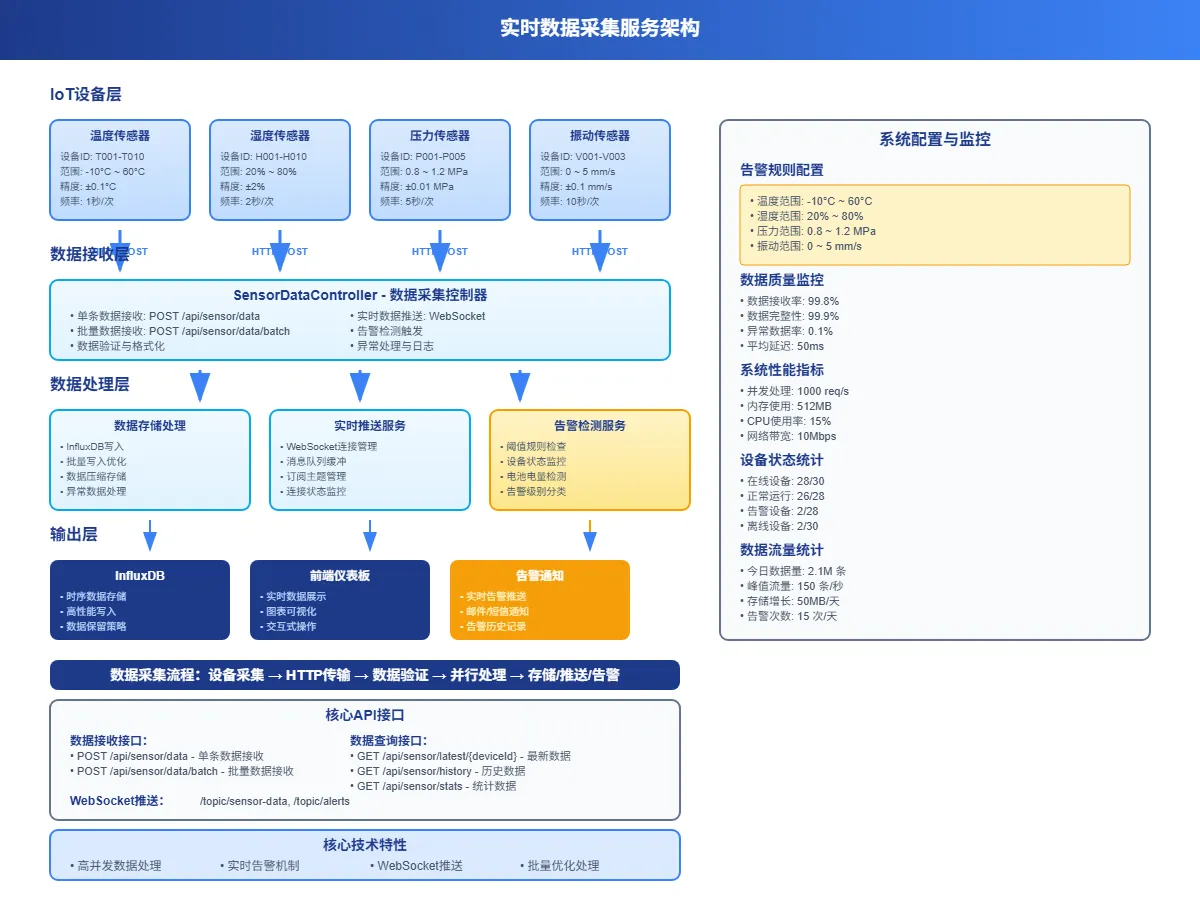
实时数据采集服务架构与处理流程
数据接收控制器
javaimport org.springframework.beans.factory.annotation.Autowired;
import org.springframework.web.bind.annotation.*;
import org.springframework.messaging.simp.SimpMessagingTemplate;

import java.util.List;
import java.util.Map;

@RestController
@RequestMapping("/api/sensor")
@CrossOrigin(origins = "*")
public class SensorDataController {

    @Autowired
    private SensorDataRepository sensorDataRepository;

    @Autowired
    private SimpMessagingTemplate messagingTemplate;

    @Autowired
    private AlertService alertService;

    // 接收传感器数据
    @PostMapping("/data")
    public ResponseResult receiveSensorData(@RequestBody SensorDataRequest request) {
        try {
            // 数据验证
            if (request.getDeviceId() == null || request.getValue() == null) {
                return ResponseResult.error("设备ID和数值不能为空");
            }

            // 创建传感器数据对象
            SensorData sensorData = new SensorData(
                request.getDeviceId(),
                request.getSensorType(),
                request.getLocation(),
                request.getWorkshop(),
                request.getValue(),
                request.getStatus()
            );

            if (request.getBattery() != null) {
                sensorData.setBattery(request.getBattery());
            }

            // 写入数据库
            sensorDataRepository.writeSensorData(sensorData);

            // 实时推送到前端
            messagingTemplate.convertAndSend("/topic/sensor-data", sensorData);

            // 检查告警条件
            alertService.checkAlerts(sensorData);

            return ResponseResult.success("数据接收成功");

        } catch (Exception e) {
            return ResponseResult.error("数据处理失败: " + e.getMessage());
        }
    }

    // 批量接收传感器数据
    @PostMapping("/data/batch")
    public ResponseResult receiveBatchSensorData(@RequestBody List<SensorDataRequest> requests) {
        try {
            List<SensorData> sensorDataList = requests.stream()
                .map(request -> new SensorData(
                    request.getDeviceId(),
                    request.getSensorType(),
                    request.getLocation(),
                    request.getWorkshop(),
                    request.getValue(),
                    request.getStatus()
                ))
                .toList();

            // 批量写入
            sensorDataRepository.writeSensorDataBatch(sensorDataList);

            // 批量推送
            messagingTemplate.convertAndSend("/topic/sensor-data-batch", sensorDataList);

            return ResponseResult.success("批量数据接收成功,共处理 " + requests.size() + " 条数据");

        } catch (Exception e) {
            return ResponseResult.error("批量数据处理失败: " + e.getMessage());
        }
    }

    // 获取最新传感器数据
    @GetMapping("/latest/{deviceId}")
    public ResponseResult getLatestData(@PathVariable String deviceId,
                                      @RequestParam(defaultValue = "10") int limit) {
        try {
            List<SensorData> data = sensorDataRepository.getLatestSensorData(deviceId, limit);
            return ResponseResult.success(data);
        } catch (Exception e) {
            return ResponseResult.error("查询失败: " + e.getMessage());
        }
    }

    // 获取历史数据
    @GetMapping("/history")
    public ResponseResult getHistoryData(@RequestParam String deviceId,
                                       @RequestParam String sensorType,
                                       @RequestParam String startTime,
                                       @RequestParam String endTime) {
        try {
            Instant start = Instant.parse(startTime);
            Instant end = Instant.parse(endTime);

            List<SensorData> data = sensorDataRepository.getSensorDataByTimeRange(
                deviceId, sensorType, start, end);

            return ResponseResult.success(data);
        } catch (Exception e) {
            return ResponseResult.error("查询历史数据失败: " + e.getMessage());
        }
    }

    // 获取聚合统计数据
    @GetMapping("/stats")
    public ResponseResult getAggregatedStats(@RequestParam String deviceId,
                                           @RequestParam String sensorType,
                                           @RequestParam(defaultValue = "5m") String timeWindow,
                                           @RequestParam(defaultValue = "24") int hours) {
        try {
            List<Map<String, Object>> data = sensorDataRepository.getAggregatedData(
                deviceId, sensorType, timeWindow, hours);

            return ResponseResult.success(data);
        } catch (Exception e) {
            return ResponseResult.error("查询统计数据失败: " + e.getMessage());
        }
    }
}

// 请求数据模型
class SensorDataRequest {
    private String deviceId;
    private String sensorType;
    private String location;
    private String workshop;
    private Double value;
    private Integer status;
    private Double battery;

    // getters and setters...
}

// 响应结果模型
class ResponseResult {
    private boolean success;
    private String message;
    private Object data;

    public static ResponseResult success(Object data) {
        ResponseResult result = new ResponseResult();
        result.success = true;
        result.data = data;
        return result;
    }

    public static ResponseResult error(String message) {
        ResponseResult result = new ResponseResult();
        result.success = false;
        result.message = message;
        return result;
    }

    // getters and setters...
}
告警服务实现
javaimport org.springframework.beans.factory.annotation.Autowired;
import org.springframework.messaging.simp.SimpMessagingTemplate;
import org.springframework.stereotype.Service;

import java.time.Instant;
import java.util.HashMap;
import java.util.Map;

@Service
public class AlertService {

    @Autowired
    private SimpMessagingTemplate messagingTemplate;

    // 告警规则配置
    private final Map<String, AlertRule> alertRules = new HashMap<>();

    public AlertService() {
        // 初始化告警规则
        alertRules.put("temperature", new AlertRule("温度", -10.0, 60.0));
        alertRules.put("humidity", new AlertRule("湿度", 20.0, 80.0));
        alertRules.put("pressure", new AlertRule("压力", 0.8, 1.2));
        alertRules.put("vibration", new AlertRule("振动", 0.0, 5.0));
    }

    public void checkAlerts(SensorData sensorData) {
        AlertRule rule = alertRules.get(sensorData.getSensorType());
        if (rule == null) return;

        Double value = sensorData.getValue();
        if (value == null) return;

        // 检查是否超出正常范围
        if (value < rule.getMinValue() || value > rule.getMaxValue()) {
            Alert alert = new Alert(
                sensorData.getDeviceId(),
                sensorData.getSensorType(),
                rule.getName(),
                value,
                rule.getMinValue(),
                rule.getMaxValue(),
                "数值超出正常范围",
                Instant.now()
            );

            // 发送告警
            sendAlert(alert);
        }

        // 检查设备状态
        if (sensorData.getStatus() != null && sensorData.getStatus() != 0) {
            Alert alert = new Alert(
                sensorData.getDeviceId(),
                sensorData.getSensorType(),
                rule.getName(),
                value,
                null,
                null,
                "设备状态异常",
                Instant.now()
            );

            sendAlert(alert);
        }

        // 检查电池电量
        if (sensorData.getBattery() != null && sensorData.getBattery() < 20.0) {
            Alert alert = new Alert(
                sensorData.getDeviceId(),
                "battery",
                "电池电量",
                sensorData.getBattery(),
                20.0,
                100.0,
                "电池电量过低",
                Instant.now()
            );

            sendAlert(alert);
        }
    }

    private void sendAlert(Alert alert) {
        // 推送到前端
        messagingTemplate.convertAndSend("/topic/alerts", alert);

        // 这里可以添加其他告警方式,如邮件、短信等
        System.out.println("告警: " + alert.getMessage() +
                          " - 设备: " + alert.getDeviceId() +
                          " - 当前值: " + alert.getCurrentValue());
    }
}

// 告警规则类
class AlertRule {
    private String name;
    private Double minValue;
    private Double maxValue;

    public AlertRule(String name, Double minValue, Double maxValue) {
        this.name = name;
        this.minValue = minValue;
        this.maxValue = maxValue;
    }

    // getters and setters...
}

// 告警信息类
class Alert {
    private String deviceId;
    private String sensorType;
    private String sensorName;
    private Double currentValue;
    private Double minValue;
    private Double maxValue;
    private String message;
    private Instant timestamp;

    public Alert(String deviceId, String sensorType, String sensorName,
                Double currentValue, Double minValue, Double maxValue,
                String message, Instant timestamp) {
        this.deviceId = deviceId;
        this.sensorType = sensorType;
        this.sensorName = sensorName;
        this.currentValue = currentValue;
        this.minValue = minValue;
        this.maxValue = maxValue;
        this.message = message;
        this.timestamp = timestamp;
    }

    // getters and setters...
}
监控仪表板实现
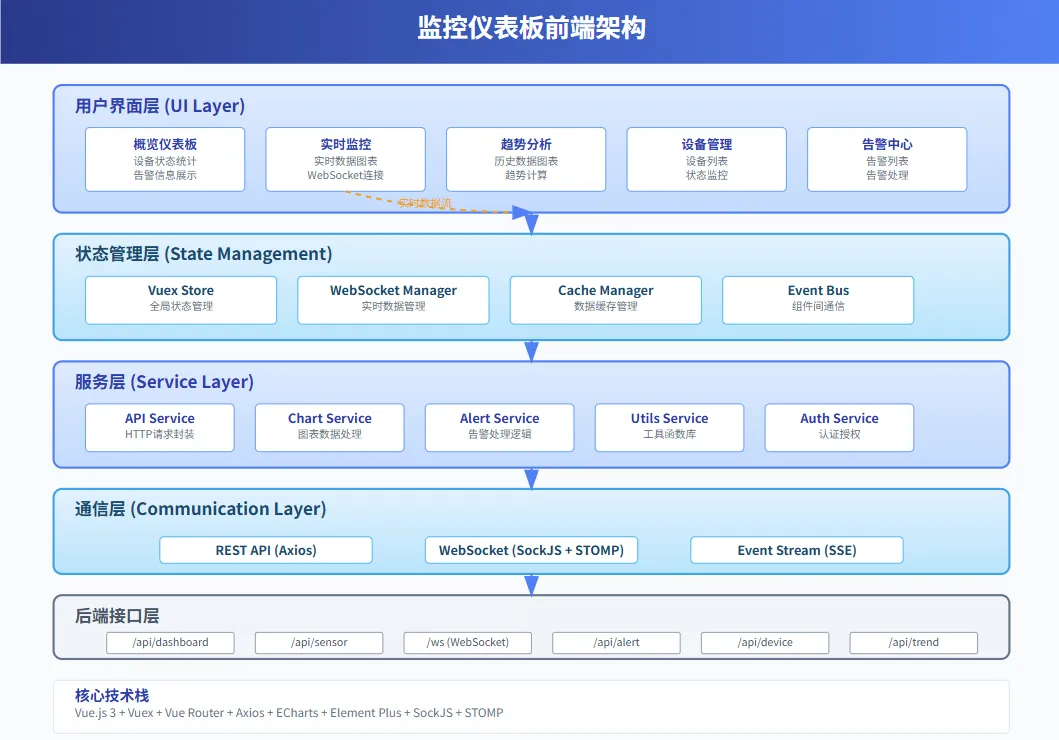
监控仪表板前端架构与组件设计
设备监控控制器
java@RestController
@RequestMapping("/api/dashboard")
@CrossOrigin(origins = "*")
public class DashboardController {

    @Autowired
    private SensorDataRepository sensorDataRepository;

    // 获取仪表板概览数据
    @GetMapping("/overview")
    public ResponseResult getDashboardOverview() {
        try {
            Map<String, Object> overview = new HashMap<>();

            // 设备状态统计
            Map<String, Object> deviceStats = sensorDataRepository.getDeviceStatusStats();
            overview.put("deviceStats", deviceStats);

            // 最新数据统计
            overview.put("latestDataCount", getLatestDataCount());

            // 告警统计
            overview.put("alertStats", getAlertStats());

            return ResponseResult.success(overview);
        } catch (Exception e) {
            return ResponseResult.error("获取概览数据失败: " + e.getMessage());
        }
    }

    // 获取实时数据流
    @GetMapping("/realtime/{deviceId}")
    public ResponseResult getRealtimeData(@PathVariable String deviceId) {
        try {
            List<SensorData> data = sensorDataRepository.getLatestSensorData(deviceId, 50);
            return ResponseResult.success(data);
        } catch (Exception e) {
            return ResponseResult.error("获取实时数据失败: " + e.getMessage());
        }
    }

    // 获取趋势分析数据
    @GetMapping("/trend")
    public ResponseResult getTrendData(@RequestParam String deviceId,
                                     @RequestParam String sensorType,
                                     @RequestParam(defaultValue = "1h") String timeWindow,
                                     @RequestParam(defaultValue = "24") int hours) {
        try {
            List<Map<String, Object>> trendData = sensorDataRepository.getAggregatedData(
                deviceId, sensorType, timeWindow, hours);

            // 计算趋势指标
            Map<String, Object> result = new HashMap<>();
            result.put("data", trendData);
            result.put("trend", calculateTrend(trendData));

            return ResponseResult.success(result);
        } catch (Exception e) {
            return ResponseResult.error("获取趋势数据失败: " + e.getMessage());
        }
    }

    private int getLatestDataCount() {
        // 这里可以实现获取最近5分钟的数据量统计
        return 1250; // 示例数据
    }

    private Map<String, Object> getAlertStats() {
        Map<String, Object> alertStats = new HashMap<>();
        alertStats.put("totalAlerts", 15);
        alertStats.put("criticalAlerts", 3);
        alertStats.put("warningAlerts", 12);
        return alertStats;
    }

    private Map<String, Object> calculateTrend(List<Map<String, Object>> data) {
        if (data.size() < 2) {
            return Map.of("direction", "stable", "change", 0.0);
        }

        Double firstValue = (Double) data.get(0).get("value");
        Double lastValue = (Double) data.get(data.size() - 1).get("value");

        if (firstValue == null || lastValue == null) {
            return Map.of("direction", "stable", "change", 0.0);
        }

        double change = ((lastValue - firstValue) / firstValue) * 100;
        String direction = change > 5 ? "up" : change < -5 ? "down" : "stable";

        return Map.of("direction", direction, "change", Math.round(change * 100.0) / 100.0);
    }
}
WebSocket 配置
javaimport org.springframework.context.annotation.Configuration;
import org.springframework.messaging.simp.config.MessageBrokerRegistry;
import org.springframework.web.socket.config.annotation.EnableWebSocketMessageBroker;
import org.springframework.web.socket.config.annotation.StompEndpointRegistry;
import org.springframework.web.socket.config.annotation.WebSocketMessageBrokerConfigurer;

@Configuration
@EnableWebSocketMessageBroker
public class WebSocketConfig implements WebSocketMessageBrokerConfigurer {

    @Override
    public void configureMessageBroker(MessageBrokerRegistry config) {
        // 启用简单消息代理
        config.enableSimpleBroker("/topic");
        // 设置应用程序目标前缀
        config.setApplicationDestinationPrefixes("/app");
    }

    @Override
    public void registerStompEndpoints(StompEndpointRegistry registry) {
        // 注册STOMP端点
        registry.addEndpoint("/ws")
                .setAllowedOriginPatterns("*")
                .withSockJS();
    }
}
数据模拟器
数据模拟器生成流程与策略设计
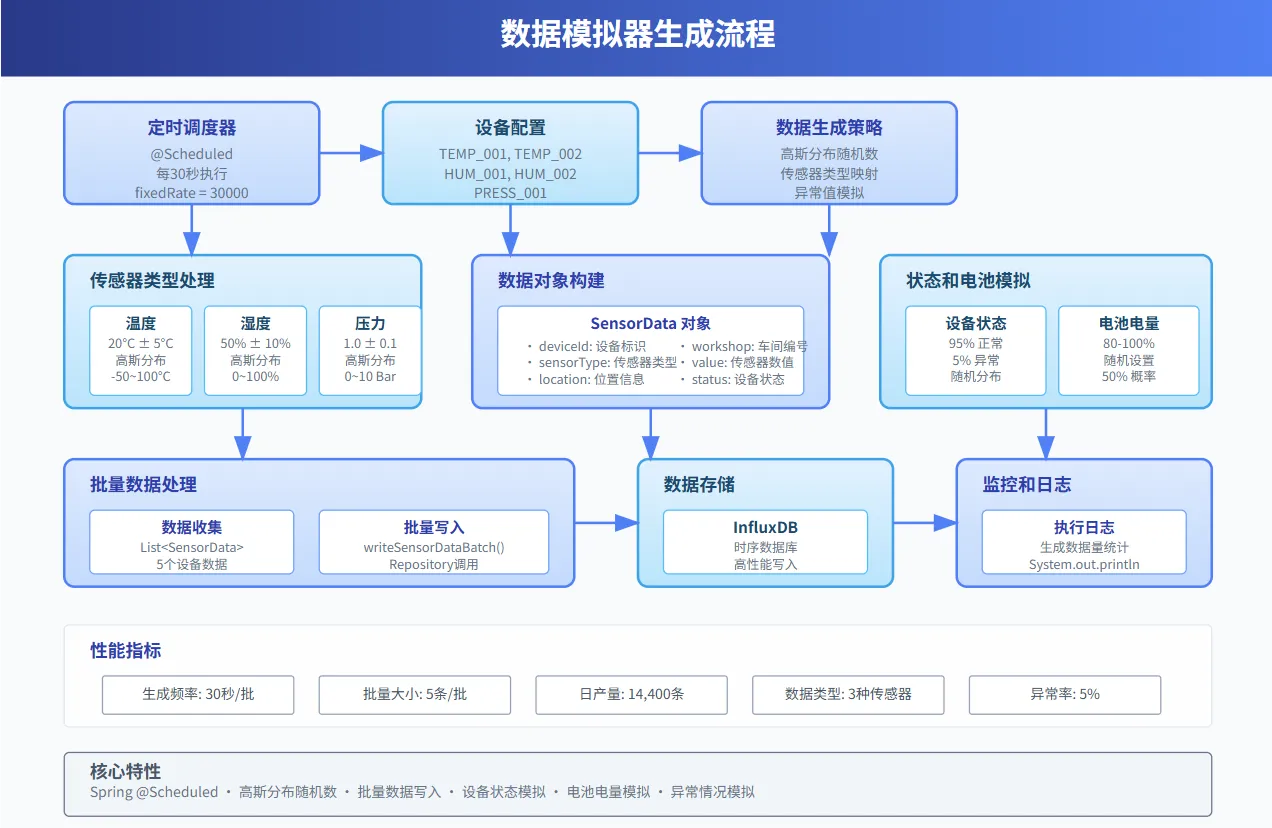
为了测试系统,我们创建一个数据模拟器来生成传感器数据:
javaimport org.springframework.beans.factory.annotation.Autowired;
import org.springframework.scheduling.annotation.Scheduled;
import org.springframework.stereotype.Component;

import java.util.ArrayList;
import java.util.List;
import java.util.Random;

@Component
public class SensorDataSimulator {

    @Autowired
    private SensorDataRepository sensorDataRepository;

    private final Random random = new Random();
    private final String[] deviceIds = {"TEMP_001", "TEMP_002", "HUM_001", "HUM_002", "PRESS_001"};
    private final String[] locations = {"车间A", "车间B", "车间C", "仓库", "办公区"};
    private final String[] workshops = {"WS001", "WS002", "WS003", "WS004", "WS005"};

    // 每30秒生成一批模拟数据
    @Scheduled(fixedRate = 30000)
    public void generateSimulatedData() {
        List<SensorData> dataList = new ArrayList<>();

        for (String deviceId : deviceIds) {
            String sensorType = getSensorType(deviceId);
            SensorData data = new SensorData(
                deviceId,
                sensorType,
                locations[random.nextInt(locations.length)],
                workshops[random.nextInt(workshops.length)],
                generateSensorValue(sensorType),
                random.nextInt(100) < 95 ? 0 : 1 // 95%概率正常状态
            );

            // 随机设置电池电量
            if (random.nextBoolean()) {
                data.setBattery(80.0 + random.nextDouble() * 20.0);
            }

            dataList.add(data);
        }

        // 批量写入
        sensorDataRepository.writeSensorDataBatch(dataList);

        System.out.println("生成了 " + dataList.size() + " 条模拟传感器数据");
    }

    private String getSensorType(String deviceId) {
        if (deviceId.startsWith("TEMP")) return "temperature";
        if (deviceId.startsWith("HUM")) return "humidity";
        if (deviceId.startsWith("PRESS")) return "pressure";
        return "unknown";
    }

    private Double generateSensorValue(String sensorType) {
        switch (sensorType) {
            case "temperature":
                return 20.0 + random.nextGaussian() * 5.0; // 平均20度,标准差5度
            case "humidity":
                return 50.0 + random.nextGaussian() * 10.0; // 平均50%,标准差10%
            case "pressure":
                return 1.0 + random.nextGaussian() * 0.1; // 平均1.0,标准差0.1
            default:
                return random.nextDouble() * 100;
        }
    }
}
性能优化与最佳实践
性能优化策略对比分析与效果评估
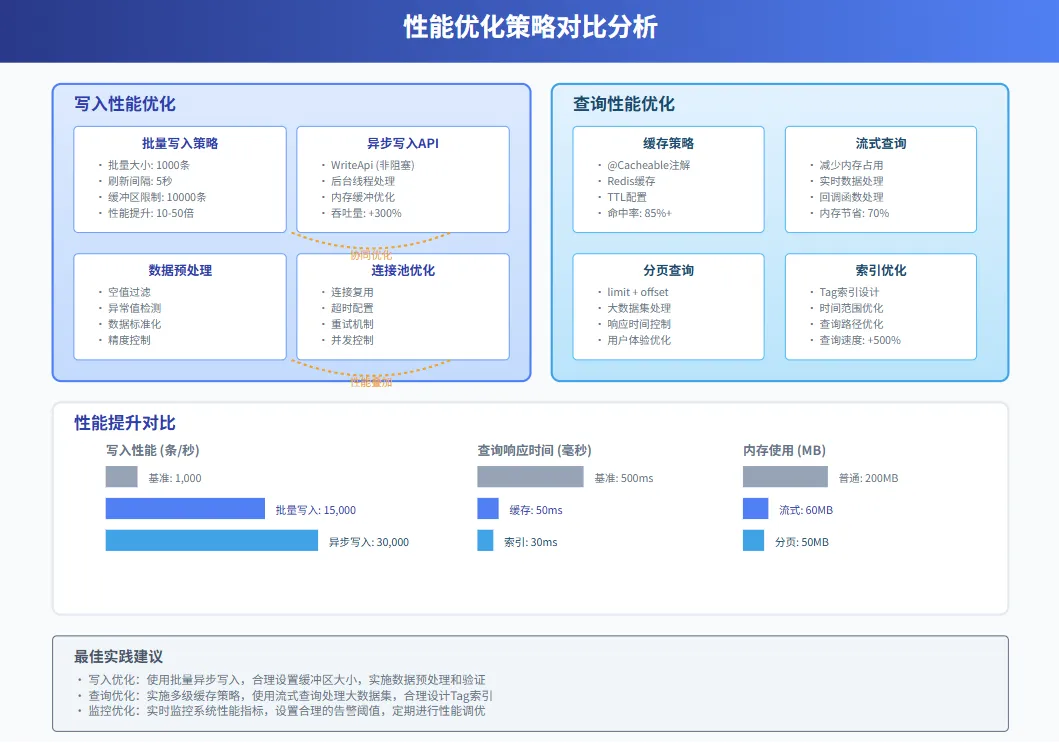
批量写入优化
java@Service
public class OptimizedDataService {

    @Autowired
    private InfluxDBClient influxDBClient;

    @Value("${influxdb.bucket}")
    private String bucket;

    @Value("${influxdb.org}")
    private String org;

    // 使用异步写入API提高性能
    public void writeDataAsync(List<SensorData> dataList) {
        WriteApi writeApi = influxDBClient.getWriteApi(
            WriteOptions.builder()
                .batchSize(1000)
                .flushInterval(5000)
                .bufferLimit(10000)
                .build()
        );

        writeApi.writeMeasurements(WritePrecision.NS, dataList);
        writeApi.close(); // 确保数据被刷新
    }

    // 数据压缩和预处理
    public List<SensorData> preprocessData(List<SensorData> rawData) {
        return rawData.stream()
            .filter(data -> data.getValue() != null) // 过滤空值
            .filter(data -> isValidRange(data)) // 过滤异常值
            .map(this::normalizeData) // 数据标准化
            .collect(Collectors.toList());
    }

    private boolean isValidRange(SensorData data) {
        Double value = data.getValue();
        String type = data.getSensorType();

        switch (type) {
            case "temperature":
                return value >= -50 && value <= 100;
            case "humidity":
                return value >= 0 && value <= 100;
            case "pressure":
                return value >= 0 && value <= 10;
            default:
                return true;
        }
    }

    private SensorData normalizeData(SensorData data) {
        // 数据精度控制
        if (data.getValue() != null) {
            data.setValue(Math.round(data.getValue() * 100.0) / 100.0);
        }
        return data;
    }
}
查询性能优化
java@Service
public class OptimizedQueryService {

    @Autowired
    private InfluxDBClient influxDBClient;

    @Value("${influxdb.bucket}")
    private String bucket;

    @Value("${influxdb.org}")
    private String org;

    // 使用连接池和缓存优化查询
    @Cacheable(value = "sensorData", key = "#deviceId + '_' + #hours")
    public List<Map<String, Object>> getCachedAggregatedData(String deviceId, int hours) {
        String flux = String.format("""
            from(bucket: "%s")
              |> range(start: -%dh)
              |> filter(fn: (r) => r["_measurement"] == "sensor_data")
              |> filter(fn: (r) => r["device_id"] == "%s")
              |> aggregateWindow(every: 5m, fn: mean, createEmpty: false)
            """, bucket, hours, deviceId);

        return executeOptimizedQuery(flux);
    }

    // 分页查询大数据集
    public List<SensorData> getPagedSensorData(String deviceId, int page, int size) {
        int offset = page * size;

        String flux = String.format("""
            from(bucket: "%s")
              |> range(start: -24h)
              |> filter(fn: (r) => r["_measurement"] == "sensor_data")
              |> filter(fn: (r) => r["device_id"] == "%s")
              |> sort(columns: ["_time"], desc: true)
              |> limit(n: %d, offset: %d)
            """, bucket, deviceId, size, offset);

        return executeQueryForSensorData(flux);
    }

    private List<Map<String, Object>> executeOptimizedQuery(String flux) {
        QueryApi queryApi = influxDBClient.getQueryApi();

        // 使用流式查询减少内存占用
        List<Map<String, Object>> result = new ArrayList<>();

        queryApi.query(flux, org, (cancellable, record) -> {
            Map<String, Object> dataPoint = new HashMap<>();
            dataPoint.put("timestamp", record.getTime());
            dataPoint.put("value", record.getValue());
            result.add(dataPoint);
        });

        return result;
    }
}
这个物联网监控系统展示了 InfluxDB 在实际项目中的应用。通过合理的数据模型设计、高效的批量写入、实时数据推送和智能告警机制,我们构建了一个完整的时序数据处理平台。
系统的核心优势包括:高并发数据写入能力、灵活的查询和聚合功能、实时监控和告警、可扩展的架构设计。这些特性让它能够很好地适应各种物联网和监控场景的需求。
如果对你有用的话,可以打赏哦
打赏


本文作者:柳始恭
本文链接:
版权声明:本博客所有文章除特别声明外,均采用 BY-NC-SA 许可协议。转载请注明出处!
目录